



A successful business website: tips from Galaxy IT
In today's digital world, a website is not just a business card for your business, but a powerful tool for attracting customers...
We are a team of specialists that has been built
We are a team of specialists that has been built and was studying for many years, subsequently achieving ideal results in various IT areas.
/ABOUT GALAXY IT INC.

We are a team of specialists that has been built
We are a team of specialists that has been built and was studying for many years, subsequently achieving ideal results in various IT areas.

We are a team of specialists that has been built
We are a team of specialists that has been built and was studying for many years, subsequently achieving ideal results in various IT areas.

We are a team of specialists that has been built
We are a team of specialists that has been built and was studying for many years, subsequently achieving ideal results in various IT areas.

Understanding business website development pricing in 2026 can be challenging, as costs vary widely from one project to another. The final investment depends on your business goals, required functionality, project complexity and long-term growth plans. Knowing what is typically included at each budget level helps you set realistic expectations and choose a solution that delivers the best long-term value.
Website pricing often feels inconsistent because there is no universal standard for what a project includes in websites development. Two similar-looking proposals can deliver very different results in terms of customization, functionality and long-term value. Differences in design, strategy, integrations and support all influence the final cost, so it’s important to evaluate scope rather than price alone.
Not every agency includes the same services in its website development package. Some focus only on design and coding, while others include strategy, SEO foundations, content structure, analytics and third-party integration services.
Many published prices reflect only a starting point. A quoted website cost often excludes content creation, advanced functionality, CRM integration, custom forms, hosting or future updates. As a result, the initial price can differ significantly from the final investment once all business requirements are taken into account.
A frequent misunderstanding is that website pricing is based solely on the number of pages required. In reality, conversion goals, user experience, automation requirements, and scalability have a much larger impact on the average website cost.

While this range does not include extensive custom functionality, it’s enough to build a professional business website that establishes credibility, supports lead generation and creates a strong online presence. It’s a practical choice for companies that need essential features with room for future growth.
Ideal for local service providers, consultants, startups and basic business site launches. This range delivers a professional online presence without complex custom functionality.
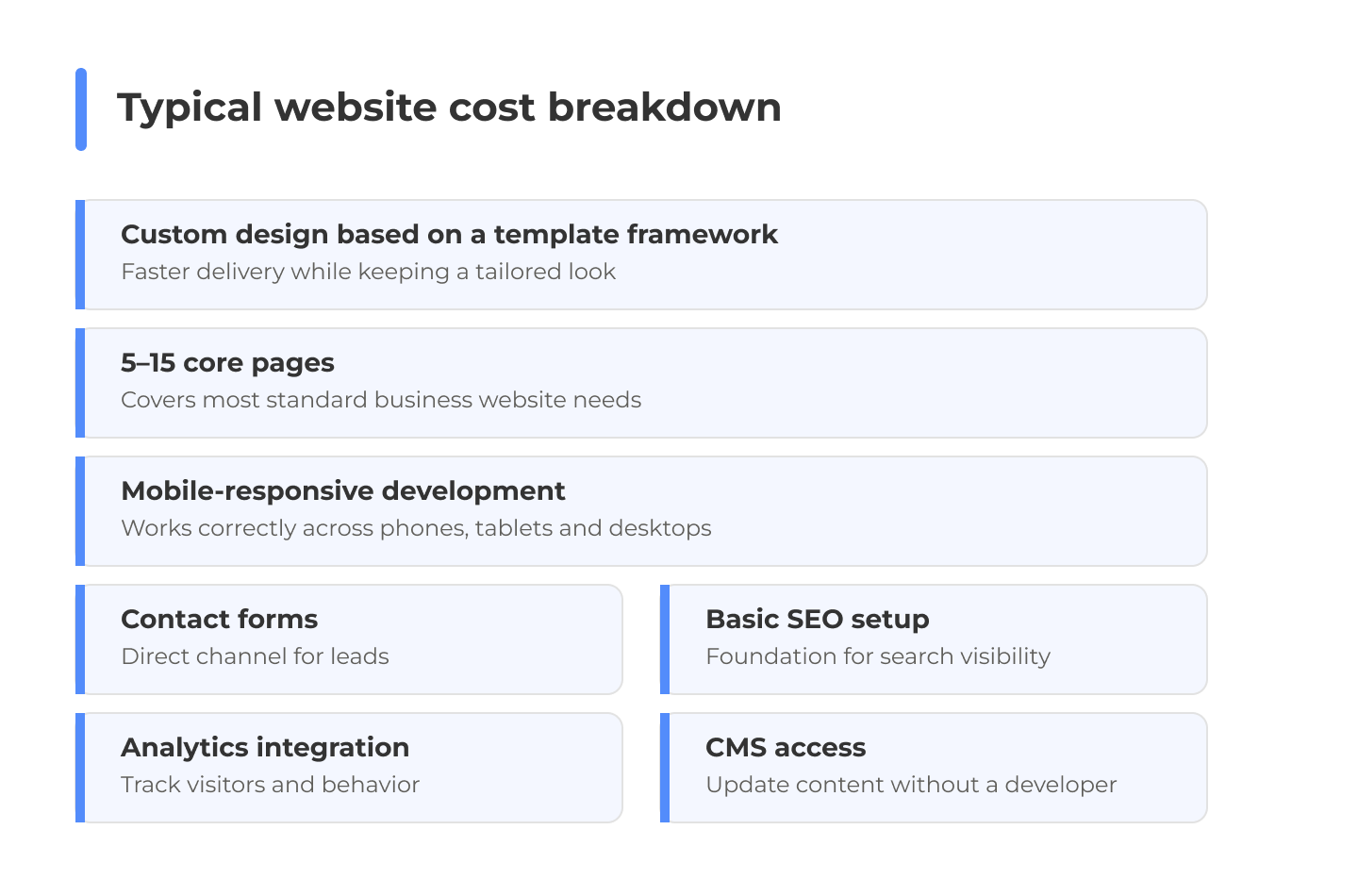
Typical website cost breakdown:
At this level, companies can invest in user experience, conversion optimization and integrations that support marketing, sales and long-term growth objectives. The focus moves beyond appearance toward measurable business performance.
This level includes UX research, conversion-focused design, CRM and marketing automation integration, custom service pages, advanced SEO, lead generation systems, and performance optimization. You can also review real portfolio projects to see how these approaches are applied in practice.
At the $8K–$20K level, businesses invest in improvements that boost performance, UX and growth. This often includes custom design, conversion-focused UX, CRM or third-party integrations, stronger SEO and scalable functionality for future needs.
Projects over $20,000 are driven by business complexity rather than design alone. Companies operating across multiple markets, handling large data volumes or needing custom workflows often require solutions beyond standard website functionality.
Higher budgets make sense when organizations need custom systems, multiple integrations, advanced workflows or specialized functionality.
These projects often include:
At the $20K+ level, businesses invest in fully custom web development focused on scalability, performance and complex functionality. This includes advanced architecture, integrations, custom workflows, API development and strong security.
These projects also prioritize long-term scalability, performance optimization and seamless user experience across all devices, supported by modern UX design and often delivered by a Laravel development team or similar dedicated setup for ongoing improvements.
What's included at every Galaxy IT budget level:

Choosing the right budget is not about the lowest price but about long-term business impact. A well-planned investment should align with your growth goals, operational needs and the role your website plays in generating revenue and supporting customers.
A lower initial investment can sometimes create additional costs later, including redesigns, feature upgrades and scalability improvements as business requirements evolve. Even a basic builder solution may eventually require migration to support future growth.
It should reflect revenue goals, lead generation needs, integrations, content volume, growth expectations and technical complexity. When evaluating website pricing, focus on outcomes rather than cost. The right investment depends on what your website must achieve and should support long-term growth, leads and measurable value.


