



A successful business website: tips from Galaxy IT
In today's digital world, a website is not just a business card for your business, but a powerful tool for attracting customers...
We are a team of specialists that has been built
We are a team of specialists that has been built and was studying for many years, subsequently achieving ideal results in various IT areas.
/ABOUT GALAXY IT INC.

We are a team of specialists that has been built
We are a team of specialists that has been built and was studying for many years, subsequently achieving ideal results in various IT areas.

We are a team of specialists that has been built
We are a team of specialists that has been built and was studying for many years, subsequently achieving ideal results in various IT areas.

We are a team of specialists that has been built
We are a team of specialists that has been built and was studying for many years, subsequently achieving ideal results in various IT areas.


Understanding Laravel development services is about much more than comparing an hourly rate. Many businesses focus on finding the lowest rate, only to discover later that delays, rework, and missed requirements significantly increase the total project budget.
When comparing Laravel vendors, businesses often focus on the hourly rate. However, this can be misleading. The total project cost depends on many factors, including efficiency, expertise, communication and the ability to deliver the right solution without expensive revisions.
Many companies ask, "What is the hourly rate?" before discussing project requirements. While the average hourly rate is an important factor, it rarely reflects the total Laravel development cost.
A lower rate may require:
Projects rarely fail because of developer pricing alone. More often, budgets increase because of unclear requirements, poor communication or technical mistakes that require rework.
The true cost often comes from:
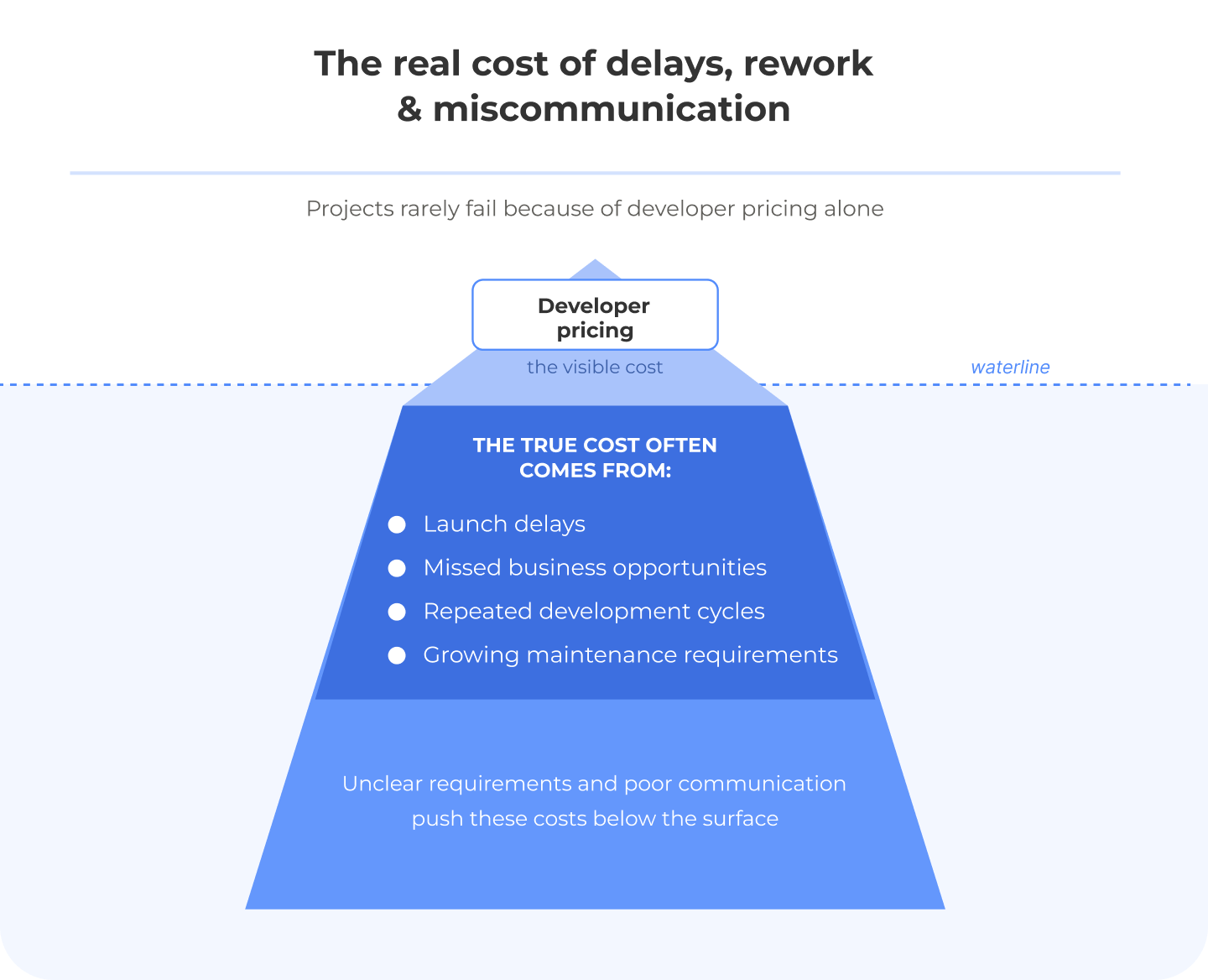
Instead of focusing on the hourly rate alone, evaluate experience, delivery quality and business understanding. A skilled Laravel specialist may complete work faster and with fewer issues than a lower-cost alternative.
Laravel pricing depends on more than development hours. The final cost is shaped by project complexity, technical requirements, team structure, and the level of customization. Whether you're building a customer portal, SaaS platform, or Laravel ecommerce solution, understanding these factors helps set realistic budgets and evaluate estimates more accurately.
The biggest factor behind Laravel development cost is project complexity. A simple customer portal requires a different investment than a SaaS platform or enterprise system.
Key factors include:
Custom features, integrations, and technical challenges often increase both development cost and delivery time. This includes payment systems, ERP or CRM connections, reporting tools, third-party APIs and custom web design that supports unique business workflows. Each integration adds implementation effort, testing and technical complexity.
A single freelancer may be suitable for small projects. Larger products often require a complete Laravel development team, including developers, QA specialists, designers and project managers.

One of the biggest challenges in project budgeting is uncertainty. The less defined a project's requirements are at the start, the harder it becomes to predict costs accurately. Understanding how scope evolves helps businesses set realistic expectations and reduce financial risk throughout development.
Early estimates are based on available information. As business goals become clearer, the project scope often expands and estimates are updated accordingly.
A structured discovery phase helps identify risks before development starts.
Benefits include:
The better defined the scope, the lower the budget risk.

Choosing the right pricing model is just as important as choosing the right development team and IT solutions. Each approach has advantages, but the best option depends on how clearly the project requirements are defined and how likely they are to change during development.
A fixed-price model works best when project requirements are clear, stable and fully defined before development starts. It is usually a good fit for small projects, simple MVPs or solutions with a limited set of features.

For most business applications, time & material offers greater flexibility. As priorities change, resources can be allocated where they create the highest value.
This model often provides:
Accurate estimates are built on accurate information. The more clearly a business defines its goals, requirements and expectations, the easier it becomes for development teams to provide realistic pricing and reduce the risk of unexpected costs later in the project.
To provide an accurate estimate, development teams need a clear overview of your project, including business goals, features, user flows, integrations and timeline expectations. The more structured the input, the more precise the cost estimate and the fewer assumptions during planning.
Be cautious when estimates are far below market averages.
Common red flags include:
Ultimately, Laravel development cost depends on requirements, complexity and execution. Successful projects focus on value, scalability and long-term results rather than the lowest price.