



A successful business website: tips from Galaxy IT
In today's digital world, a website is not just a business card for your business, but a powerful tool for attracting customers...
We are a team of specialists that has been built
We are a team of specialists that has been built and was studying for many years, subsequently achieving ideal results in various IT areas.
/ABOUT GALAXY IT INC.

We are a team of specialists that has been built
We are a team of specialists that has been built and was studying for many years, subsequently achieving ideal results in various IT areas.

We are a team of specialists that has been built
We are a team of specialists that has been built and was studying for many years, subsequently achieving ideal results in various IT areas.

We are a team of specialists that has been built
We are a team of specialists that has been built and was studying for many years, subsequently achieving ideal results in various IT areas.

Many businesses don’t clearly understand the deep difference, which often leads to poor budgeting, unrealistic timelines and costly rebuilds. Understanding it early helps choose the right IT solutions and helps choose the right approach and avoid unnecessary expenses.
The difference between a website and a web application directly impacts scope, cost and timelines. Even if they look similar, they may require very different architecture, functionality and support.
The main difference between a web app and website comes down to functionality. A website primarily delivers information, while a web application allows users to perform actions, process data and interact with business systems. If your goal is to scale this functionality, you need to make a web application.
Many companies treat their project as a simple website when they actually need a web application. This leads to poor planning, inaccurate budgets and a gap between expectations and real technical requirements.
A simple website may require a designer and developer. Building a web app often involves:
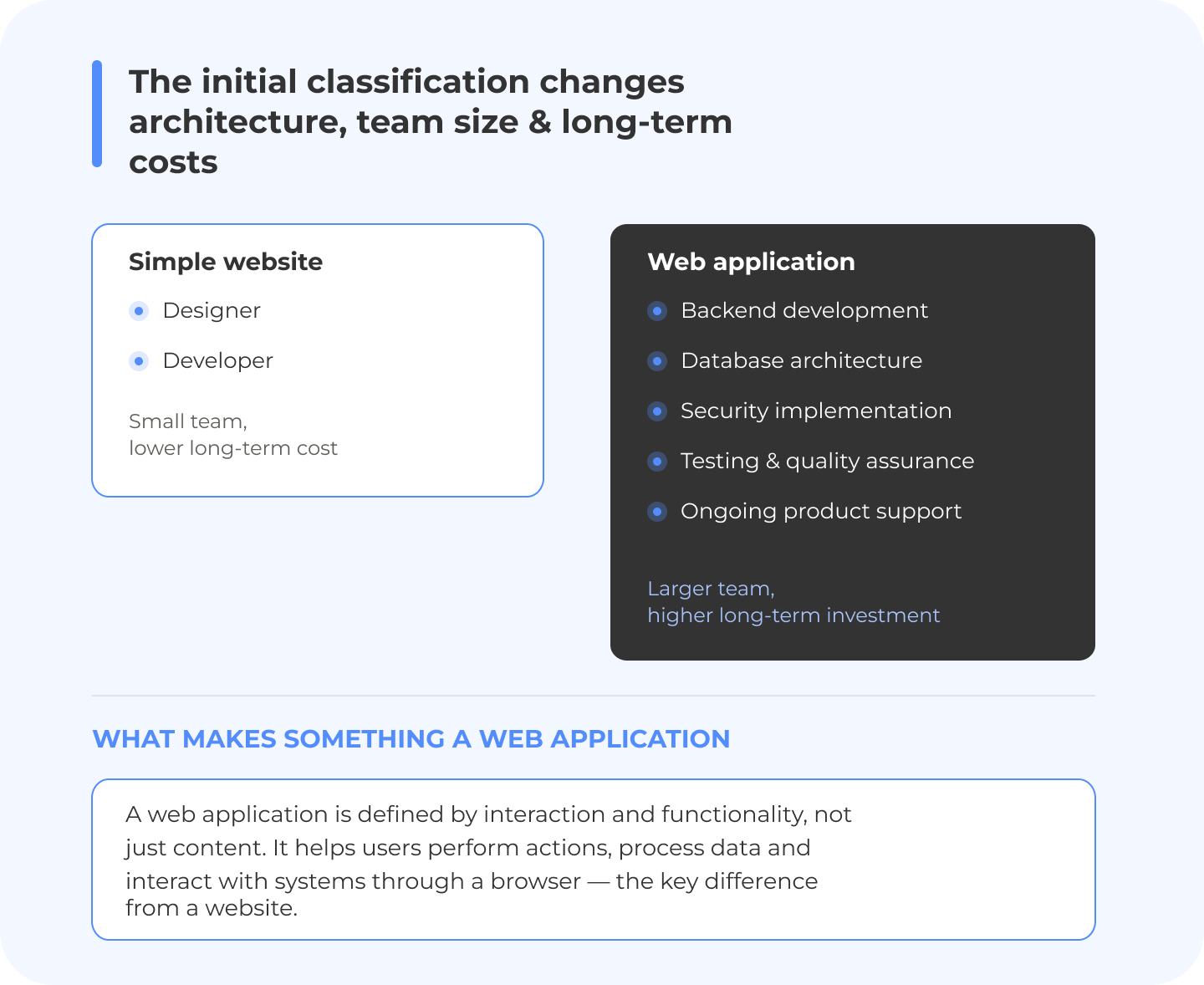
A web application is defined by interaction and functionality, not just content. It helps users perform actions, process data and interact with systems through a web browser, which is the key difference between a web site.
Web app is software accessed through a web browser that enables users to complete tasks rather than simply read content.
Common examples include:
When a product includes user accounts, permissions, workflows or automation, it goes beyond the simple web app vs website distinction and becomes a full software solution.

Understanding different types of web applications helps businesses choose the right architecture based on functionality, scalability and user experience. Not every project requires the same level of complexity, so classification is a key step in planning.
Modern businesses use different types of web applications based on their goals and functionality. These include static apps with fixed content, dynamic apps with user-driven updates, single-page applications (SPA) with fast navigation and progressive web applications (PWA) that offer mobile-like performance. You can explore real examples in our portfolio projects.

More advanced web applications support real-time communication, payments and automated processes. These features make them more powerful than standard websites and improve user engagement.
Choosing between a website and a web application depends on how users will interact with your product. The key is understanding whether your goal is information delivery or functional interaction through a web browser.
If your main goal is to provide structured and accessible information, a website is usually the right choice. Websites focus on clear communication, simple navigation and strong search visibility, helping users quickly find what they need and understand your services. This approach is ideal for informational and marketing purposes, where content delivery is the priority rather than interaction.
If you are planning to make a websites, this model ensures a strong foundation for visibility and lead generation.

If users need to actively interact with your product, a web application is the better choice. It supports login, data management, requests, tracking and task completion, making it suitable for products with ongoing user interaction and personalized experiences.
Choosing between a website and a web application is not just a technical decision - it directly affects budget, timelines and long-term product stability. Misclassification at the early stage often leads to avoidable financial and operational risks.
When a software product is treated as a simple website, teams often encounter unexpected requirements during development. This can lead to scope expansion, launch delays, technical debt and higher development costs.
The opposite issue occurs when businesses choose complex application architecture for projects that only need a standard website. This increases costs, slows development and adds unnecessary complexity without added value.
Deciding between a website and a web application early is crucial. The right choice helps avoid extra costs, delays and structural limitations later in development.
The choice between apps and websites shouldn’t be based on appearance. It depends on user interaction and business processes like workflows, data, automation and integrations.
Clear classification helps businesses:
The key question is the problem users are solving, not whether it’s a website or a web application. This defines the right solution or combination of both.